 OrbitForge
G01
LEO Earth observation
S-band TT&C up, X-band payload down, classic TC/TM operations over sun-synchronous passes.
leo-eo.sso-single-station5 missions · 22 scenariosTM, TC, AOS, USLP, Space Packet and PUS-C on ns-3, across 17 reference missions from LEO to Mars.
One window for the whole mission.

Satellites, stations and footprints move with the run; nodes under attack are marked.
Every station-to-satellite pass as it opens and closes, with injections on the same clock.
Dataset rows, attack rows, pcap size, latency and delivery while the simulation runs.
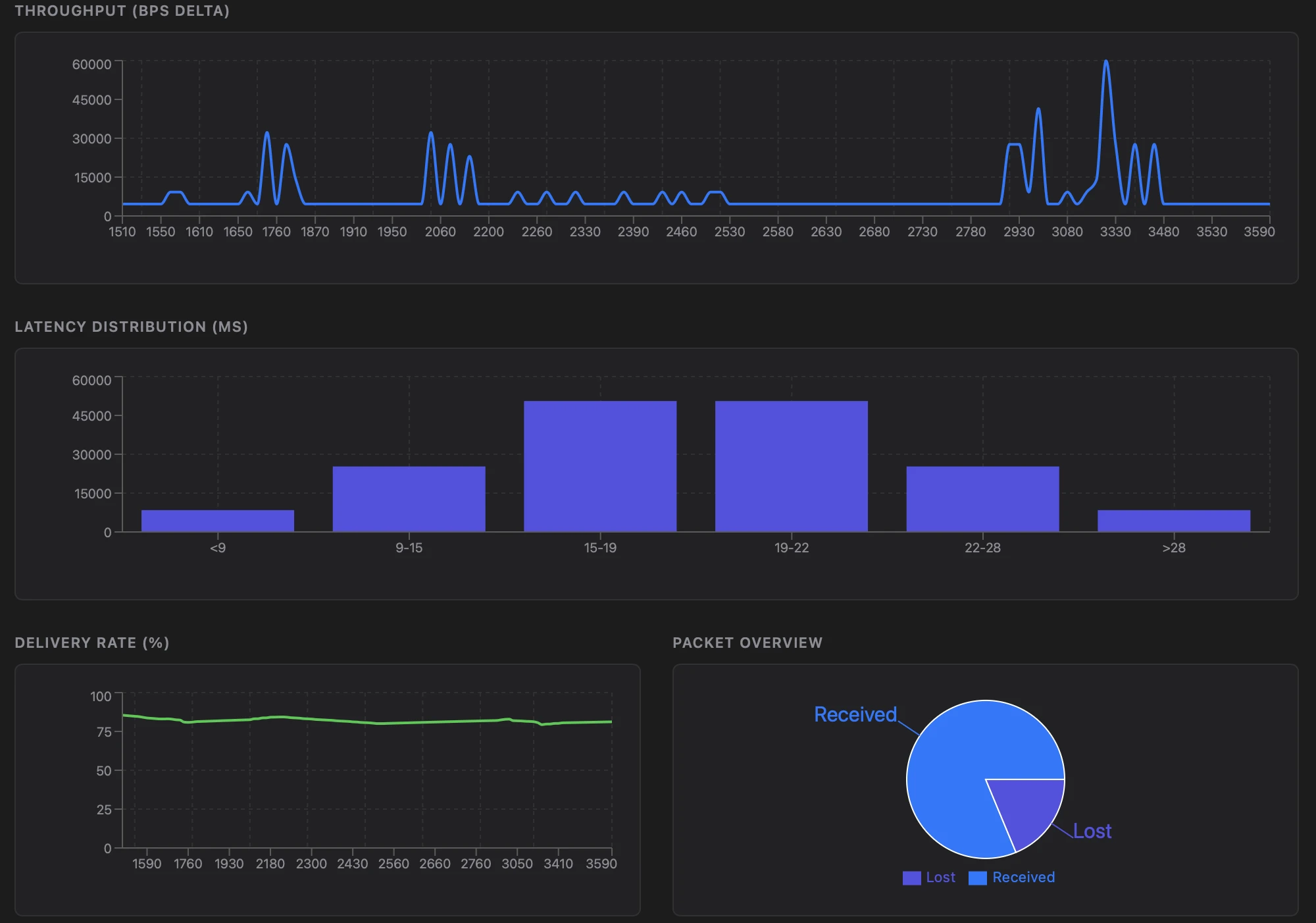
Throughput, latency, delivery rate and packet loss as soon as the run ends.
17 reference missions, 76 scenarios.
S-band TT&C up, X-band payload down, classic TC/TM operations over sun-synchronous passes.
leo-eo.sso-single-station5 missions · 22 scenariosA mega-constellation shell with user terminals, gateways and inter-satellite links.
broadband-leo.shell-user-segment2 missions · 8 scenariosThousands of sensors sending tiny messages, stored onboard and forwarded at the next gateway.
iot-d2s.uhf-store-forward1 mission · 5 scenariosKa/Ku high-throughput user beams with weather-driven adaptive coding and modulation.
geo-comsat.ka-hts-europe2 missions · 9 scenariosA LEO spacecraft talking to the ground through a GEO relay, TDRS and EDRS style.
data-relay.leo-via-geo-ka1 mission · 4 scenariosA Mars orbiter to the DSN over X/Ka band, with light time, solar conjunction, CFDP and DTN.
deep-space.mars-orbiter-dsn1 mission · 5 scenariosA rover relaying through an orbiter over UHF Proximity-1.
mars-proximity.rover-orbiter-uhf1 mission · 4 scenariosA lunar relay serving surface users, with DTN and IP over CCSDS.
lunar.lunanet-relay-lander1 mission · 4 scenariosCross-support between stations of several agencies over a WAN.
ground-network.cross-support-sle1 mission · 6 scenariosHosted payloads sharing a spacecraft, and a matrix of six security postures under identical seeds.
multi-tenant.security-posture-matrix2 missions · 9 scenariosResearchers, engineers and reviewers each get what they came for.
Labelled CCSDS traffic from missions that behave like real ones: contact-gated flows, playback at AOS, CFDP transactions.
Every mission closes its RF links with margin at minimum elevation before any protocol runs on top.
Each run reports what it executed, approximated and does not support; tests run from spec checks to regression.
And a report of exactly what each run simulated.
Space Packet 133.0-B-2, PUS-C ECSS-E-ST-70-41C, CFDP Class 2 727.0-B-5, Bundle Protocol v7 RFC 9171
TM 132.0-B-3, TC with COP-1 and CLTU 232.0-B-4, AOS 732.0-B-4, USLP 732.1-B-2, Proximity-1
SDLS 355.0-B-1 with authentication or AEAD and OTAR key rotation, BPSec RFC 9172, on OpenSSL
Link budgets, ITU-R propagation, Doppler, light time, ACM, interference, hardware chains
ns-3.43 discrete-event simulator
One installer with the app, the ns-3 runner and the whole mission catalog. Nothing else to build.